
1972
The
Young
Turk


View the teaser or read the docustory below:

The First Skirmish
Just four months into his tenure at the South African Jewish Board of Deputies (SAJBD), Mendel was already kicking up dust.
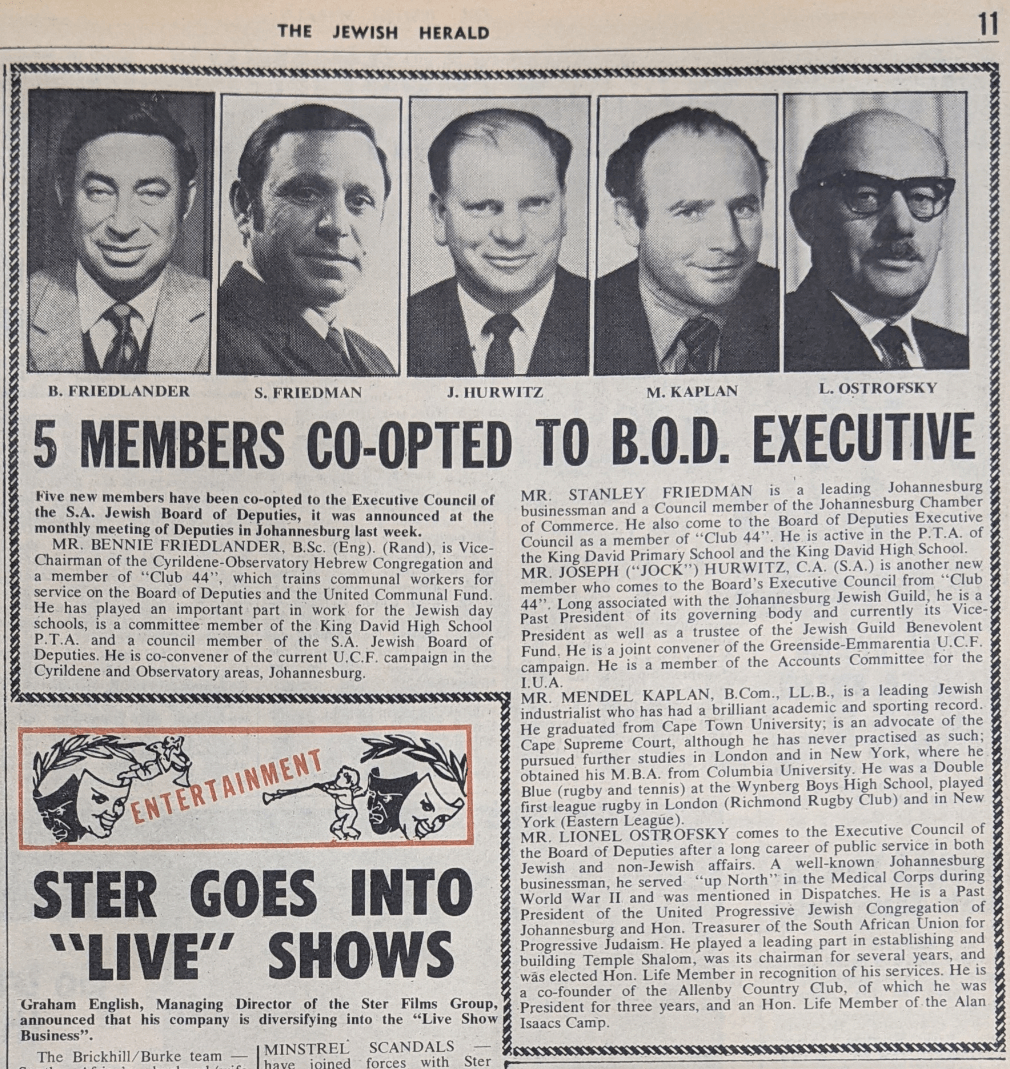
Armed with ambition and a sharp pen, he drafted a provocative questionnaire aimed at improving the organisation’s management.
Among its pointed questions was a direct challenge: “Do the secretariat dominate the other organs by either ignoring or delaying the implementation of decisions with which they disagree?”
This was no idle inquiry, but likely a thinly veiled accusation targeting the entrenched bureaucracy at the SAJBD. Gus Saron, a Board stalwart for 36 years, bristled at the 36-year-old upstart’s insinuation. He denounced the implied critique as “unjust” and a smear against himself and his secretariat colleagues. Despite Mendel’s freshman status the Board refused to withdraw the question, insisting that no “personal imputation [was] intended.” What followed was a “full and frank discussion” at the Board table—(probably) a heated exchange that laid bare the emerging fault lines within the institution.


The Broader Battle
In the early 1970s, the South African Zionist Federation reigned supreme in Jewish communal life. Yet Mendel chose to dedicate his energy to the Board of Deputies—a venerable institution with a mission to represent all Jewish organisations in South Africa.

Mendel is seated in the front row, third from the left, with Gus Saron directly behind him.
But Mendel wasn’t content to play a supporting role. From the outset, his vision was audacious: a comprehensive long-term restructuring of the Board and, by extension, how the community functioned as whole.
His guiding principle was unequivocal: Jewish institutions must be fit for purpose and deliver on their objectives. This became a lifelong commitment. He wanted communal structures to be more ambitious, more responsive, and more effective. In service of this agenda, every facet had to be reconsidered, from governance to fundraising.

Within two years, the Board’s landscape had shifted, Saron had departed, and a new executive director had been appointed, heralding a transformative era under Mendel’s influence.


Cast of Characters

Mendel at 36
Mendel had just joined the Oxford Shul committee and was co-opted to the SAJBD Executive in May 1972.

Gustav ‘Gus’ Saron (1905-1989)
The long-serving General Secretary of the SAJBD. A former academic, Saron had contributed to and edited A History of South African Jews.

The Honorary Officers of the South African Jewish Board of Deputies
This body, filled with attorneys and advocates, included many former elected Board officials. It was a recurring target of Mendel’s criticism.
Organisations
The South African Jewish Board of Deputies (SAJBD)
Founded in 1912, the SAJBD serves as the representative body for South African Jewry, addressing communal needs and safeguarding Jewish interests across the region.
South African Zionist Federation (SAZF)
Established in 1898, the SAZF nurtures ties between South Africa’s Jewish community and Israel while advocating for Israel in public and political spheres.